The guide · by Metro Mode
Nice
The Riviera's capital, between the Baie des Anges and the first Alps
Nice sits on the curve of the Baie des Anges, its back to an amphitheatre of hills and the Mercantour behind them, the Var valley closing it to the west and Mont Boron to the east. Greeks from Massalia founded a settlement here and called it Nikaia after Nike, the goddess of victory; the Romans built their own town, Cemenelum, on the hill of Cimiez, where its baths and amphitheatre still stand.
For most of its history the city looked to Italy rather than to Paris. In 1388 it placed itself under the protection of the Counts of Savoy and became the capital of the County of Nice; apart from the years of the French Republic and Empire, it stayed Savoyard and then Piedmontese-Sardinian until the Treaty of Turin of 1860 ceded it to France. That long Italian chapter is legible everywhere – in the red-ochre façades of Place Masséna, modelled on a square in Turin, and in the street names of the old town.
Read on
From the second half of the eighteenth century English families began wintering here, and Nice invented the Riviera season: in the 1820s the English colony paid for the first coastal walk, the future Promenade des Anglais. Russian aristocrats followed, then the painters – Matisse, Chagall, later Arman and Niki de Saint Phalle. On 27 July 2021 UNESCO inscribed «Nice, the winter resort town of the Riviera» on the World Heritage List.
Today the city reads in layers: Vieux Nice and its market on the Cours Saleya, Le Port below the Castle Hill, the Belle Époque grid of the Musiciens and the Carré d'Or, Cimiez with its palaces and museums, Mont Boron's pines above the sea, and to the north-west the terraced vineyards of Bellet, the only appellation wine grown entirely within a large French city.
The quartiers
- City centre791
- Carré d'Or568
- Vieux Nice526
- Le Port395
- Riquier, Saint-Roch & the Acropolis325
- Libération & Borriglione219
- Fabron, Magnan & the western seafront203
- Saint-Philippe & Les Baumettes195
- Nice Nord181
- Arénas, Caucade & the Var plain178
- Gare & Thiers106
- Cimiez95
- Bellet & Saint-Isidore90
- Les Musiciens89
- Mont Boron & Mont Alban55
- Pasteur & L'Ariane50
- La Madeleine45
- The hills: Gairaut & Saint-Pancrace29
Highlights
- Place of worshipBasilique Notre-DameThe neo-Gothic basilica of 1864–1879 on Avenue Jean-Médecin, the largest church in Nice
- Place of worshipCathédrale Sainte-RéparateThe cathedral of Nice, built 1650–1699 on Place Rossetti
- Place of worshipCathédrale orthodoxe russe de Saint-NicolasThe Russian Orthodox cathedral of 1903–1912, one of the largest outside Russia
- Place of worshipChapelle de la MiséricordeThe masterpiece of the Niçois baroque, on the Cours Saleya
- Place of worshipÉglise du Gèsu, Saint-Jacques-le-MajeurThe Jesuits' baroque church on Rue Droite, begun in 1642
- MuseumMuseum d'Histoire NaturelleThe «Musée Barla»: Nice's oldest municipal museum, founded in 1846
- MuseumMusée Marc ChagallChagall's Biblical Message, in the museum he helped to plan
- MuseumMusée MassénaA Belle Époque villa on the Promenade, and Nice's museum of its own history
- MuseumMusée MatisseMatisse from first to last, in a seventeenth-century Genoese villa on Cimiez
- MuseumMusée d'art moderne et d'art contemporainThe marble arch over the Paillon – closed for renovation, reopening announced for 2029
- MuseumMusée des Arts AsiatiquesAsian art in a building by Kenzo Tange, on the lake of Parc Phœnix
- MuseumMusée des Beaux ArtsThe city's fine-art museum, in a Genoese-Renaissance villa begun for a Russian princess
Five-star hotels
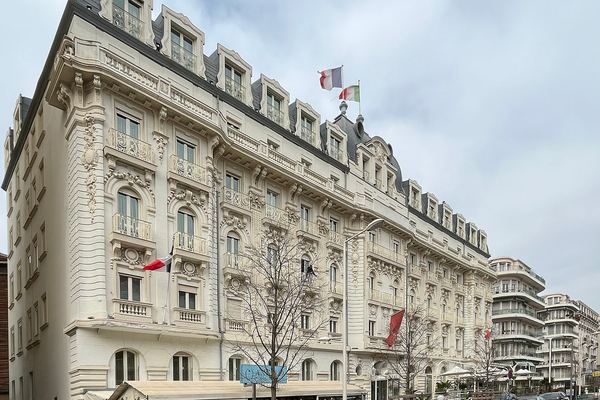 Boscolo Nice Hotel & Spa112 roomsPhoto: Benoît Prieur / Wikimedia Commons, CC0
- Hôtel Anantara Plaza Nice151 rooms
- Hôtel Negresco128 rooms
- Hôtel Palais de la Méditerranée187 rooms
- Hôtel du Couvent88 rooms
- Maison Albar Hotels le Victoria132 rooms
Lists & itineraries
Everything, by kind
Sources
- Wikipedia (en): Nice
- Wikipédia (fr) : Nice
- Wikipédia (fr) : Cimiez
- Wikipédia (fr) : Place Masséna
- Wikipédia (fr) : Promenade des Anglais
- Wikipédia (fr) : Bellet (AOC)
- Wikipedia (en): Place Masséna
- OpenStreetMap contributors (ODbL)
- Wikidata
- INSEE IRIS / IGN (Licence Ouverte 2.0)